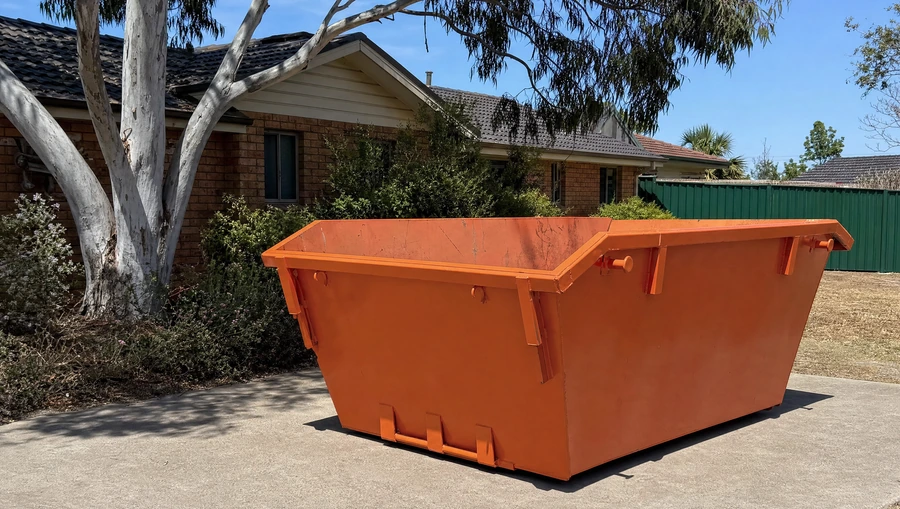
Most people pick the spot for a skip by looking at where there is room. That is the second question. The first one is whether a truck carrying a steel bin can get to that room, put it down, and get back out again.
Five minutes standing in the driveway before you book saves the worst version of delivery day, which is a truck on your street and nowhere to put the thing it is carrying.
Start with the truck, not the bin
The bin is placed from the back of a truck, which needs a clear straight run at the spot and room to work. So look at the approach before you look at the space itself:
- Can a truck get down the street and stop? Parked cars both sides of a narrow street, a tight cul-de-sac or a steep single-lane access are all worth mentioning when you book.
- Is the driveway entrance wide enough? Brick pillars, letterboxes and established garden beds either side of a crossover are the usual pinch points.
- Is there a straight run to the spot? A bin cannot be slid sideways around a corner once it is down.
- Can the truck get out again? Somewhere to turn, or a straight enough reverse to the street.
If any of that is marginal, say so when you enquire. It is not a problem until it is a surprise.
Look up before you look down
This is the one people miss. The bin is lifted on and off, so the space above the spot has to be as clear as the ground. Power lines, low branches, a carport roof, a shade sail, an awning or a first-floor balcony overhang will all rule out a spot that looks perfect from ground level.
Under a carport is never it, however tempting the shade looks. Pick a place with open sky directly above it.
What the bin is going to sit on
A full bin is heavy and it concentrates that weight on the rails it sits on. That matters more on some surfaces than others.
- Concrete driveway. The straightforward answer, and where most bins go.
- Pavers, tiles or decorative concrete. Usually fine, but it is worth laying timber under the rails if the finish matters to you. Ask us for a couple of lengths if you do not have any.
- Asphalt, in a Hunter summer. Soft bitumen and a heavy bin can mark each other. Timber underneath helps here too.
- Lawn or soft ground. Possible when it is dry and firm, poor after rain. A truck on a wet lawn leaves ruts that take longer to fix than the job did.
- Gravel or dirt. Generally fine if it is level and firm.
- Anything with services under it. Water meters, inspection pits, septic lids and stormwater grates want to stay clear.
Level matters as well as firm. A bin on a slope loads unevenly, and on a steep driveway there is a real question about whether the spot works at all — worth raising when you book.
How much room to leave
A useful rule of thumb: plan for at least the footprint of a car, plus enough space on the open side to stand and swing something into the bin without turning sideways. If you are wheeling a barrow to it, leave a path to the door end as well.
Bins vary between operators, so if the spot is tight, ask us for the actual length and width of the bin you are booking rather than working off a photograph. We would much rather answer that before it is loaded on the truck. The size guide is the place to start on which bin you need; the footprint of it is a question for the phone.
Think about the walk, not just the spot
The bin will sit there for days and you will walk to it a hundred times. The theoretically perfect placement at the very top of the driveway is worth giving up for one twenty metres closer to the garage you are actually emptying.
Two other things worth a thought before the truck arrives: whether the spot blocks a car in that somebody needs during the week, and whether the door end faces the job, so you can walk things in at the low end rather than lifting them over the side.
If the only spot is the road or the verge
Then it is not your land, and that changes the question entirely. A bin on the road, the footpath or the nature strip is on council land, and councils generally require approval for that. The rules, the process and what is involved are set by each council and they are not the same across the Hunter, so check with yours.
We have written up which council covers which town, and what the test actually is, on the council permit guide. Read that one before you assume a kerbside placement is fine.
A two-minute check before delivery
- The spot is clear — cars moved, bins moved, nothing stacked on it.
- The approach is clear, including anything parked across the driveway.
- Nothing overhead, and no branch you have been meaning to cut.
- Gates open, and any dog somewhere it will not be underfoot.
- Somebody can be reached by phone, even if nobody is going to be home.
Not sure your spot works? Describe it when you get in touch — the driveway, the surface, what is overhead and how the truck would get in. We do this every day, and we would far rather sort it out on the phone than on your kerb. If the answer turns out to be that no bin fits, rubbish removal does the same job without one.